What is a sphere?
A sphere is the three-dimensional set of points that are all the same distance from one central point. That fixed distance is the radius r. A sphere has no edges, vertices or flat faces, and every great-circle cross-section through the center is a circle with radius r.
For calculation purposes, the important idea is that a sphere has only one independent size variable. Once you know r, every other basic measurement follows from it: diameter, circumference, surface area and volume.
Radius, diameter and circumference
The diameter passes through the center and is exactly twice the radius. At the widest great-circle section, the circumference behaves like an ordinary circle with radius r, so C = 2πr.
Sphere formulas
These are the standard relationships used by the calculator. Length quantities use the chosen unit; areas are in square units and volume is in cubic units.
Why the exponents are different
Surface area contains r², while volume contains r³. That difference is not cosmetic. If radius doubles, surface area becomes four times larger but volume becomes eight times larger.
How to find the radius from other measurements
The calculator can start from radius, diameter, circumference, surface area or volume. In every case, it first recovers r, then evaluates the rest.
What happens when the radius changes?
For students, the most useful pattern is to connect the exponents to the geometry. A 10% increase in radius does not mean a 10% increase in surface area or volume: the powers of r amplify the change.
That is why the live scaling chart above is shown as a relative chart. It compares multipliers, not square units with cubic units, so the visual remains dimensionally meaningful.
Surface-to-volume ratio
Dividing surface area by volume gives a compact measure of how much surface is available per unit of enclosed volume:
As r increases, A/V falls. This is useful when thinking about heat transfer, coatings, biological cells, droplets and storage vessels because the same amount of volume can be associated with very different amounts of boundary surface.
Worked sphere examples
Example 1 — radius 10 cm
With r = 10 cm, diameter is 20 cm and circumference is 20π cm. The volume is 4/3π(10³) = 4000π/3 ≈ 4188.79 cm³, while surface area is 4π(10²) = 400π ≈ 1256.64 cm².
Example 2 — given diameter
Suppose a spherical object has d = 18 cm. First recover the radius: r = 18/2 = 9 cm. Then use the same core formulas. The volume becomes 972π cm³ and the surface area becomes 324π cm².
Example 3 — given volume
If V is known, solve backwards with r = ∛(3V/4π). Once r is recovered, diameter, circumference and surface area can all be calculated without a second geometric model.
Where sphere calculations are used
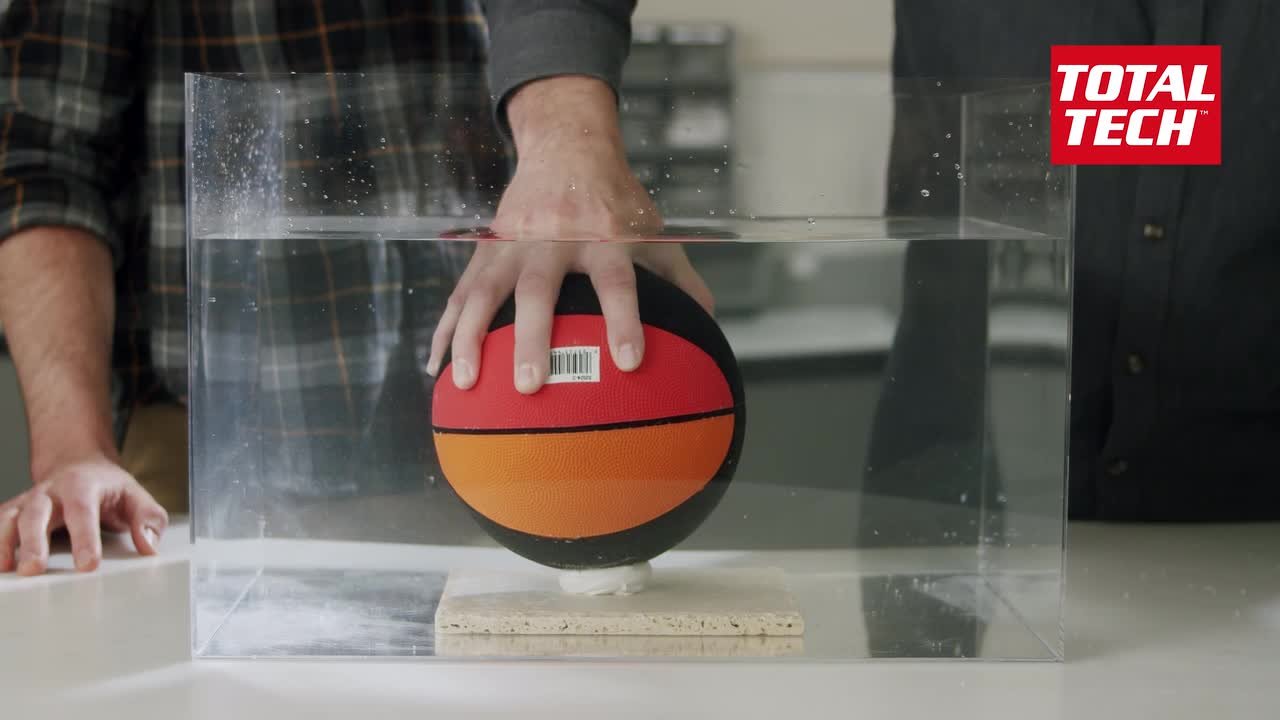
Sphere formulas appear in storage, manufacturing, sports and geometry. Water towers can use spherical tanks, while sports objects and laboratory models are often approximated as spheres when estimating volume or surface area.

Common mistakes to avoid
- Using diameter where a formula expects radius.
- Reporting surface area with cubic units or volume with square units.
- Comparing raw area and volume numbers as if they had the same dimensions.
- Forgetting that the sphere's great-circle circumference is 2πr.
- Rounding r too early before calculating area or volume.
Sphere calculator FAQ
A circle is a two-dimensional set of points in a plane. A sphere is a three-dimensional surface in space. A plane through the center of a sphere produces a great circle.
V = 4/3πr³. The radius must be cubed, so a small change in r can create a much larger change in volume.
A = 4πr². Surface area is measured in square units such as cm², m² or ft².
Yes. Recover the radius with r = C/(2π), then calculate the remaining properties.
Because volume scales with r³, doubling the radius multiplies volume by 8. Surface area scales with r², so it becomes 4 times larger.
A/V = 3/r, so larger spheres have less surface area per unit of volume. This relationship helps explain why scale matters in many physical systems.